
DSC Thermal Analysis for Polymer Testing and Quality Control
Understanding how a polymer behaves when heated or cooled is essential for material development, manufacturing and quality control. Two plastic materials may look almost identical, yet differences in formulation, crystallinity, additives or processing history can significantly affect their thermal behavior and long term performance.
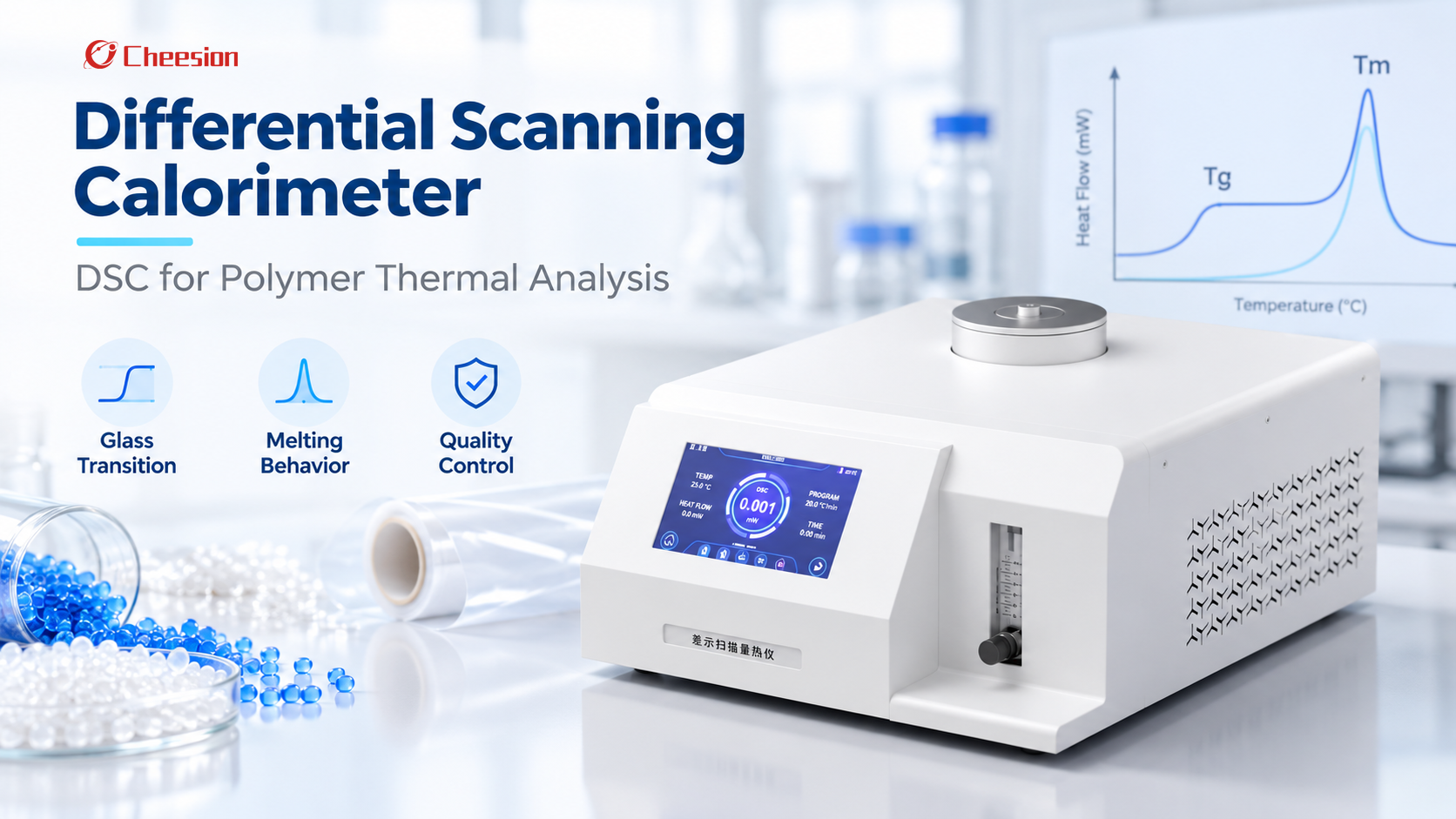
Differential Scanning Calorimetry DSC provides laboratories and manufacturers with a direct method for studying these differences. A Differential Scanning Calorimeter measures changes in heat flow while a sample follows a controlled temperature program. The resulting DSC curve can reveal important thermal transitions such as glass transition, melting, crystallization and oxidation behavior.
For polymer manufacturers, cable producers, PE pipe companies, automotive suppliers and material laboratories, DSC thermal analysis can provide valuable information from raw material inspection through product development and finished product quality control.
What Does a Differential Scanning Calorimeter Measure
A DSC analyzer measures the difference in heat flow between a test sample and a reference while temperature is precisely controlled.
When the sample undergoes a physical or chemical transition, the amount of heat it absorbs or releases changes. DSC records these changes and presents them as a thermal curve.
Typical measurements include glass transition temperature Tg, melting temperature Tm, crystallization temperature Tc, melting and crystallization enthalpy, degree of crystallinity and oxidation induction time OIT.
These parameters help engineers understand not only what a material is, but also how it may behave during processing, storage and actual use.
Glass Transition Temperature and Polymer Performance
Glass transition temperature is one of the most important parameters in polymer characterization.
Below its glass transition region, an amorphous polymer or amorphous portion of a semi crystalline polymer tends to behave more rigidly. Above this region, molecular mobility increases and the material becomes more flexible.
Measuring Tg can therefore help researchers evaluate service temperature, formulation changes and material consistency.
A change in glass transition temperature between two batches may indicate differences in polymer composition, plasticizer content, molecular structure or processing history. This makes DSC useful for formulation development and troubleshooting as well as routine quality control.
Melting and Crystallization Analysis
Melting and crystallization behavior provides additional information about polymer structure and processing conditions.
During heating, DSC can determine the melting temperature and associated melting enthalpy. During cooling, it can identify the crystallization temperature and crystallization enthalpy.
These measurements can help manufacturers compare polymer grades, evaluate material purity and investigate the effect of cooling rate, additives or manufacturing conditions.
For semi crystalline polymers such as polyethylene and polypropylene, crystallization behavior can have an important influence on mechanical properties, dimensional stability and processing performance.
DSC data can therefore help connect laboratory material characterization with real production conditions.
Measuring Polymer Crystallinity
The degree of crystallinity is another important property for many polymer materials.
Using measured melting enthalpy together with appropriate reference data, DSC can be used to estimate polymer crystallinity. Differences in crystallinity may influence stiffness, density, barrier properties, dimensional stability and other performance characteristics.
For manufacturers comparing raw materials or investigating unexpected product performance, crystallinity data can provide valuable information that may not be visible through conventional inspection.
Oxidation Induction Time for PE Pipes Films and Cables
Oxidation Induction Time OIT is an important DSC application for evaluating the oxidative stability of polymer materials.
Polyethylene products often contain antioxidant systems designed to slow oxidative degradation during processing and long term service. OIT testing helps assess the effectiveness and consistency of these stabilization systems under controlled test conditions.
This measurement is particularly relevant for PE pipes, geomembranes, plastic films, cable insulation and cable sheathing.
For a PE pipe manufacturer, for example, OIT testing can support incoming resin verification, formulation comparison and production quality control. If different production batches show significantly different oxidation behavior, quality teams can investigate the raw material, antioxidant system or manufacturing process before the product reaches the market.
DSC for Incoming Material Inspection
Material inconsistency is a common challenge in manufacturing.
Two raw material batches supplied under the same commercial grade may still show differences caused by resin composition, additives, processing history or supplier variation.
DSC provides an additional method for comparing these materials.
A quality control laboratory can compare melting peaks, crystallization behavior, glass transition temperature or oxidation induction time against an approved reference material. Significant deviations may indicate that further investigation is required before the material enters production.
This makes DSC particularly useful for supplier verification and incoming material quality control.
DSC in Polymer Research and Formulation Development
In research and development, DSC can help teams compare new formulations before committing to large scale production.
Researchers can study how additives, stabilizers, fillers or formulation changes affect thermal transitions. They can also compare different polymers or blends to understand compatibility and thermal behavior.
For engineering plastics, rubber related materials, composites, automotive components and advanced materials, DSC provides objective thermal data that can support material selection and process optimization.
Rather than relying only on mechanical testing or visual observations, development teams can use DSC to understand what is happening at the thermal and structural level.
How DSC Supports Production Quality Control
DSC is not limited to academic research.
Manufacturing laboratories can use the technique to compare incoming materials, production samples and finished products. By establishing reference DSC curves or acceptable parameter ranges, quality teams can identify abnormal materials and investigate process deviations.
For example, changes in crystallization temperature may indicate differences in processing history. Unexpected melting behavior may suggest mixed materials. OIT variation may indicate changes in antioxidant protection.
These findings can support faster root cause analysis and more consistent production.
CHEESION DSC for Polymer Thermal Analysis
The CHEESION Differential Scanning Calorimeter is designed for material research and industrial thermal analysis. It supports heating, cooling and isothermal testing and can be used for applications including glass transition analysis, melting and crystallization testing, enthalpy measurement, crystallinity evaluation and oxidation induction time testing.
CHEESION DSC systems are suitable for polymer and plastic manufacturers, cable and wire companies, PE pipe and film producers, research institutes, universities and industrial quality control laboratories.
The appropriate DSC configuration should be selected according to the sample material, required temperature range, cooling requirements, atmosphere control and specific test method.
Why DSC Matters for Modern Material Testing
For polymer manufacturers, thermal behavior is closely connected with processing performance and product quality.
A Differential Scanning Calorimeter provides a practical way to convert these thermal changes into measurable data. From glass transition and crystallization to OIT and material comparison, DSC can support decisions throughout the material lifecycle.
For companies working with polymers, plastics, cables, pipes, films and advanced materials, integrating DSC thermal analysis into R&D and quality control can help improve material understanding, identify inconsistencies earlier and support more reliable manufacturing decisions.
CHEESION provides DSC thermal analysis solutions for laboratories and manufacturers seeking reliable material characterization, polymer testing and quality control.