
Handheld XRF Analyzer for RoHS Screening and Material Compliance Testing
Handheld XRF Analyzer for RoHS Screening and Material Compliance Testing
For manufacturers working with plastics, electronics, toys, cables, coatings and consumer products, restricted substance control is no longer only a final laboratory inspection. It increasingly starts with incoming materials, supplier verification and routine production screening.
A handheld XRF analyzer gives quality teams a practical way to perform rapid, non-destructive elemental screening directly on raw materials, components and finished products.
For RoHS-related applications, X-ray fluorescence can help screen elements such as lead Pb, cadmium Cd, mercury Hg, total chromium Cr and bromine Br, depending on the instrument configuration, calibration, material matrix and concentration range.
This makes portable XRF particularly useful for manufacturers that need to check many materials quickly before deciding which samples require more detailed laboratory confirmation.
What Is XRF RoHS Screening
XRF stands for X-ray fluorescence. An XRF spectrometer exposes the sample to primary X-rays and measures the characteristic fluorescent X-rays emitted by the elements in the material.
Because different elements produce different energy signatures, the analyzer can identify and quantify selected elements without cutting, dissolving or otherwise destroying the sample.
In a RoHS screening workflow, handheld XRF is commonly used as a first-stage inspection method. Quality teams can rapidly check plastics, metal components, coatings, electronic parts and other compatible materials for elements associated with restricted substances.
The main advantage is speed. Instead of sending every incoming component directly to a laboratory, manufacturers can use XRF to identify normal materials, unusual readings and higher-risk samples.
Why Manufacturers Use Handheld XRF for RoHS Compliance Screening
Modern products often contain materials from many suppliers. A single electronic product may include plastics, connectors, cables, solder materials, coatings, metal housings and printed circuit board components.
The compliance risk is therefore not limited to the finished product. It exists throughout the supply chain.
A handheld XRF analyzer allows manufacturers to move restricted substance screening closer to the point where materials enter production.
For example, an incoming inspection team can test plastic housings from different suppliers and compare elemental results between batches. If one batch shows an unexpectedly high lead, cadmium or bromine reading, the material can be isolated for additional investigation before it reaches assembly.
This approach can reduce the risk of non-conforming material entering production and can make supplier quality control more efficient.
XRF Testing for Plastics
Plastic is one of the most common materials tested in RoHS screening.
Plastics may contain pigments, stabilizers, fillers, flame-retardant systems and other additives. The elemental composition can therefore vary significantly between suppliers, formulations, colors and production batches.
With a portable XRF analyzer, quality inspectors can test plastic pellets, molded parts, housings, toys and other finished components without damaging the sample.
This is particularly useful when different colors or formulations need to be checked separately.
A red plastic component, for example, may have a different pigment system from the same product manufactured in another color. XRF provides a fast way to compare these materials and identify parts that may require additional chemical analysis.
For manufacturers, this makes plastic XRF testing useful not only for RoHS screening but also for supplier verification, material comparison and production quality control.
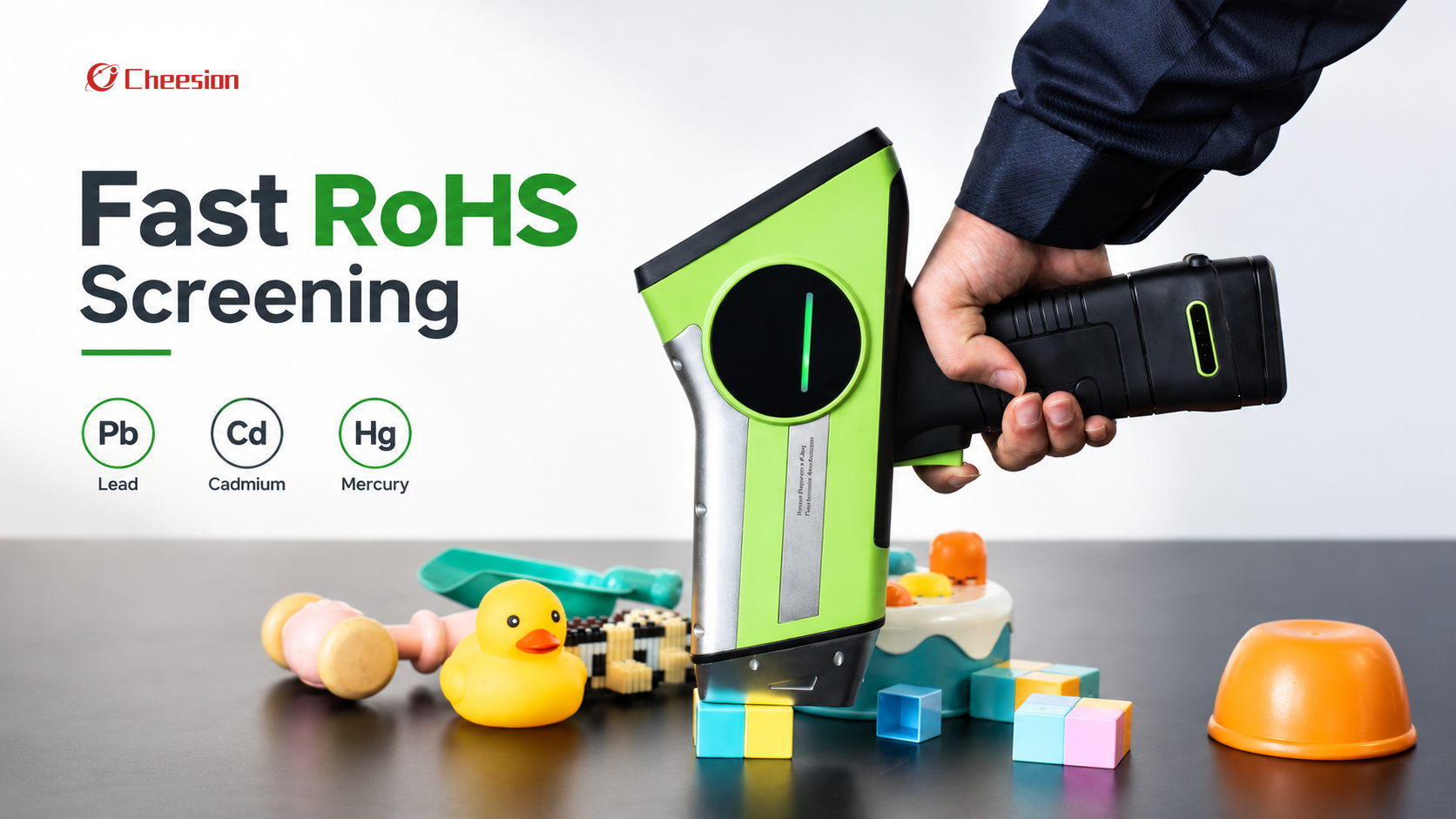
Handheld XRF for Toy and Consumer Product Testing
Toys and consumer products can contain a combination of plastics, paints, coatings, metal parts and electronic components.
Because these materials may come from different suppliers, the elemental composition of the final product can be complex.
A handheld XRF analyzer can be used to screen individual parts without dismantling or damaging the entire product. Inspectors can test different colors, coatings, plastic components or metal parts separately.
This makes XRF useful during incoming inspection, supplier audits, pre-production verification and finished-product screening.
For toy manufacturers and consumer product suppliers, rapid screening can help identify potential issues earlier in the quality process rather than waiting until final product testing.
XRF for Electronics and Electronic Components
Electronics manufacturing is another important application for RoHS screening.
Electronic products may contain connectors, cables, solder materials, metal terminals, plastic housings, coatings and printed circuit board assemblies. Each material can represent a different compliance risk.
Portable XRF allows inspectors to screen many of these components directly.
A manufacturer may use XRF during supplier qualification, incoming material inspection or production quality control to verify whether different batches remain consistent.
For high-volume electronics manufacturing, the ability to obtain fast elemental information can help quality teams focus laboratory resources on materials that actually require further analysis.
What Elements Can XRF Screen for RoHS Applications
For RoHS-related testing, XRF is commonly used to screen Pb, Cd, Hg, total Cr and Br.
This distinction is important.
XRF measures elemental composition. It does not directly identify every chemical form regulated under RoHS.
For example, an XRF analyzer can measure total chromium, but it does not independently determine how much chromium is present specifically as hexavalent chromium. Similarly, detecting bromine can indicate that brominated materials may be present, but XRF alone does not identify specific brominated compounds such as PBB or PBDE.
For this reason, handheld XRF should be regarded as a rapid RoHS screening instrument, not as a replacement for every confirmatory laboratory method.
When screening results indicate elevated concentrations or uncertain materials, appropriate laboratory testing can then be used for confirmation.
How XRF Improves Incoming Material Inspection
Incoming material inspection is one of the strongest business cases for handheld XRF.
Without rapid screening, quality teams may rely heavily on supplier documentation or randomly selected laboratory samples. Both approaches can leave gaps when large numbers of parts and batches are involved.
XRF allows manufacturers to increase testing frequency.
Materials can be checked when they arrive, before they are released to production. Results can also be compared with approved reference materials or historical supplier data.
If a batch shows unusual elemental composition, it can be quarantined and investigated before it affects downstream production.
For companies operating complex international supply chains, this creates an additional layer of material verification between supplier documentation and final compliance testing.
Supplier Verification and Production Quality Control
RoHS compliance depends heavily on supplier consistency.
A component that passed testing during initial qualification may later be manufactured with a different pigment, coating, raw material source or formulation.
Routine XRF screening gives manufacturers a way to monitor these changes.
Instead of viewing the XRF analyzer only as a laboratory instrument, companies can integrate it into supplier quality management and production control.
A quality engineer can compare current results with previously approved batches and quickly identify abnormal material changes. This can support root cause investigation, supplier communication and corrective action.
Handheld XRF Versus Laboratory RoHS Testing
Handheld XRF and laboratory chemical testing serve different roles.
XRF provides speed, portability and non-destructive multi-element screening. Laboratory methods provide more detailed chemical identification where regulatory confirmation is required.
The most efficient compliance strategy often combines both approaches.
Handheld XRF can be used to screen a large number of samples, identify potential risks and prioritize materials for further analysis. Confirmatory laboratory methods can then be focused on samples that show elevated or uncertain results.
This reduces unnecessary laboratory testing while maintaining a structured compliance workflow.
Which Industries Can Use XRF for RoHS Screening
RoHS screening with handheld XRF is relevant across a broad range of manufacturing sectors.
Typical users include electronics manufacturers, electrical equipment suppliers, toy manufacturers, plastic processors, cable and wire companies, appliance manufacturers, automotive suppliers, component manufacturers, contract manufacturers, independent testing laboratories and quality control departments.
The same instrument may also support other elemental analysis applications, depending on its configuration.
This flexibility is one reason portable XRF has become a useful material verification tool for industrial quality teams.
CHEESION Handheld XRF Analyzer for RoHS Screening
The CHEESION Handheld XRF Analyzer is designed for portable elemental analysis and industrial material verification.
For RoHS screening applications, the instrument can support rapid testing of plastics, electronic components, coatings, metal parts and consumer products for selected restricted elements.
The appropriate configuration should be selected according to the target materials, required elements, expected concentration range and testing workflow.
For manufacturers, the value of XRF is not simply obtaining an elemental result. Its greater value is allowing quality teams to make faster decisions about materials before they enter production.
A Practical RoHS Screening Workflow
A practical compliance workflow usually begins with supplier documentation and incoming material control.
Handheld XRF can then be used for rapid elemental screening. Materials with normal and consistent results can proceed according to the manufacturer's quality procedures, while unusual or elevated readings can trigger further investigation.
Where specific chemical compounds or regulatory confirmation are required, samples can then be sent for the appropriate laboratory analysis.
This combination of supplier documentation, XRF screening and confirmatory laboratory testing creates a more efficient approach to restricted substance control.
Why Handheld XRF Matters for Modern Quality Control
As global supply chains become more complex, manufacturers need faster ways to verify materials without slowing production.
A handheld XRF analyzer provides immediate elemental information while preserving the sample. It can be used at receiving inspection, in the laboratory, on the production floor or during supplier audits.
For RoHS screening, plastics testing, electronics inspection and consumer product quality control, this ability to test materials directly can significantly improve inspection efficiency.
For companies looking to strengthen incoming material inspection and supplier quality management, CHEESION Handheld XRF provides a practical solution for rapid RoHS screening and elemental material verification.