
Handheld XRF Analyzer for Soil Heavy Metal Screening and Environmental Assessment
Handheld XRF Analyzer for Soil Heavy Metal Screening and Environmental Assessment
Heavy metals in soil can be a significant concern for environmental assessment, industrial site investigation, mining operations, land redevelopment and remediation projects. When a large number of sampling points must be evaluated, relying exclusively on laboratory analysis can increase the time required to understand contamination patterns across a site.
A handheld XRF analyzer provides a practical method for rapid, non-destructive elemental screening directly in the field. By using X-ray fluorescence technology, XRF can identify and quantify a range of detectable elements in soil and sediment, helping environmental professionals obtain immediate information and make better-informed sampling decisions.
For applications such as contaminated land assessment, mining-area monitoring and soil remediation, portable XRF is particularly valuable as a field screening and decision-support tool.
How Handheld XRF Is Used for Soil Analysis
X-ray fluorescence, commonly known as XRF, works by exposing a sample to primary X-rays and measuring the characteristic secondary X-rays emitted by the elements present in the material.
For soil applications, a handheld XRF analyzer can screen multiple elements during a single measurement. Depending on the analyzer configuration, calibration, sample matrix and concentration, target elements may include lead Pb, arsenic As, chromium Cr, copper Cu, zinc Zn, nickel Ni, manganese Mn and other detectable metals.
This multi-element capability allows environmental teams to evaluate soil rapidly without destroying the sample.
Instead of waiting for laboratory results before deciding where to investigate next, field personnel can use XRF results to identify areas of elevated elemental concentration, compare different sampling locations and determine which samples should receive further laboratory confirmation.
Contaminated Land and Industrial Site Assessment
Former industrial sites, metal-processing facilities, smelters, waste disposal areas and redevelopment projects may require extensive soil investigation before land use decisions can be made.
Handheld XRF can help investigators screen soil across multiple locations and depths to understand how potential contamination is distributed.
For example, an environmental team may first conduct systematic XRF measurements across a site. Areas showing elevated readings can then be investigated more intensively, while representative samples are selected for laboratory analysis.
This approach can improve the efficiency of site characterization because laboratory resources can be focused on samples that are most relevant to the investigation.
XRF data can therefore support preliminary assessment, sampling strategy development, contamination mapping and remediation planning.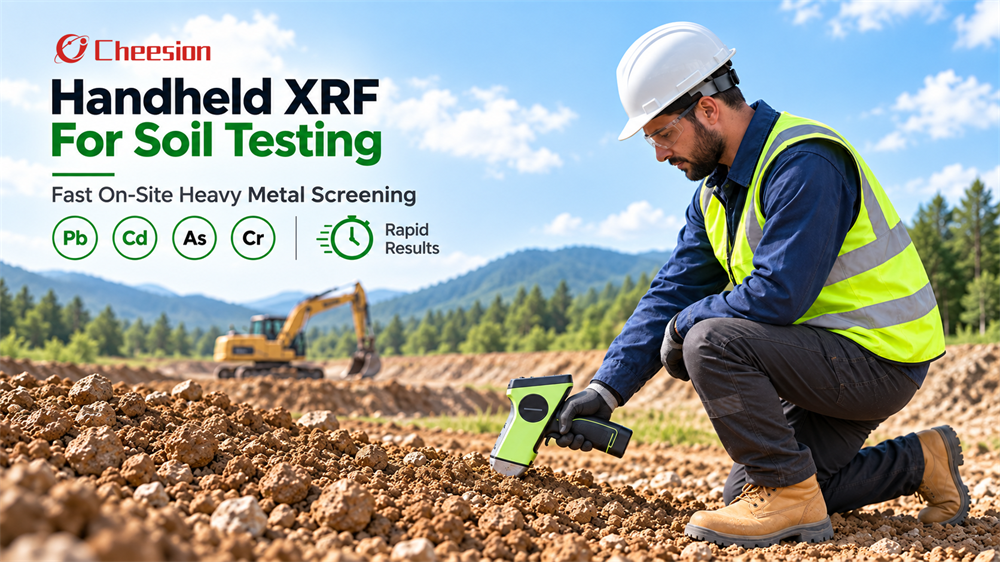
Soil Heavy Metal Screening in Mining Areas
Mining and mineral-processing activities can produce soils, waste materials, tailings and sediments with complex elemental compositions.
A portable XRF soil analyzer allows geologists and environmental personnel to perform rapid elemental measurements around mining sites, processing areas, tailings facilities and surrounding land.
The technology can help users compare elemental concentrations between different locations and identify areas that warrant additional investigation.
For mining companies, this capability can support both environmental monitoring and geological fieldwork. The same handheld instrument may be used for soil, rock, ore and other compatible solid materials when appropriate analytical methods are available.
This flexibility makes XRF especially useful for organizations that require portable elemental analysis across several field applications.
Supporting Soil Remediation Projects
Soil remediation often requires repeated measurements before, during and after treatment or excavation.
Handheld XRF can provide rapid information that helps project teams evaluate whether additional material needs to be removed, whether a treatment area requires further attention or where confirmatory laboratory samples should be collected.
Because results are available on-site, testing strategies can be adjusted while fieldwork is still in progress.
This can be particularly useful on large projects where hundreds of measurements may be required to understand spatial variation.
However, handheld XRF should not automatically be considered a replacement for regulatory laboratory methods. Where legally defensible or compliance-grade results are required, laboratory confirmation may still be necessary according to the applicable environmental regulations and testing procedures.
Why Sample Preparation Matters in XRF Soil Testing
Soil is a heterogeneous material, and several factors can influence XRF results.
Moisture content, particle size, surface condition, sample homogeneity and measurement geometry can all affect analytical performance. For this reason, the testing procedure should reflect the required level of accuracy.
Direct field measurements are useful for rapid screening. For more controlled analysis, samples may be dried, homogenized, sieved or prepared in sample cups or pressed pellets.
Multiple measurements can also be useful when evaluating heterogeneous materials.
A consistent preparation and measurement procedure improves comparability between samples and helps users obtain more meaningful XRF data.
Handheld XRF as Part of an Environmental Testing Workflow
The greatest value of handheld XRF is the ability to generate elemental information at the point of investigation.
A typical environmental workflow may combine rapid XRF screening with selected laboratory analysis. Field XRF is used to identify trends, locate potential hotspots and optimize the sampling plan, while laboratory methods are used where confirmatory or regulatory results are required.
This combined approach allows organizations to use both methods for their respective strengths.
For environmental consultants, laboratories, mining companies, research institutions and industrial facilities, handheld XRF can support faster field decisions while reducing unnecessary sample handling and improving the overall efficiency of soil investigation programs.
CHEESION Handheld XRF for Soil Heavy Metal Analysis
CHEESION Handheld XRF Analyzers are designed for portable elemental analysis in environmental monitoring, mining, geology and industrial material testing.
For soil applications, the analyzer can support rapid heavy-metal screening, contaminated land investigation, soil and sediment assessment and field-based environmental monitoring.
The appropriate XRF configuration should be selected according to the target elements, expected concentration levels, sample characteristics and analytical requirements. Calibration and sample preparation should also be matched to the intended application.
For organizations that need to screen large numbers of soil samples efficiently, handheld XRF provides a practical way to obtain rapid elemental information, improve sampling strategies and support more informed environmental decisions.